Edge AI on a budget: running vision models on a $10 microcontroller
Quantisation, tiny architectures and a power budget measured in microamps — what it takes to ship ML on cheap hardware.
 Vu Nguyen TuanEngineering Lead
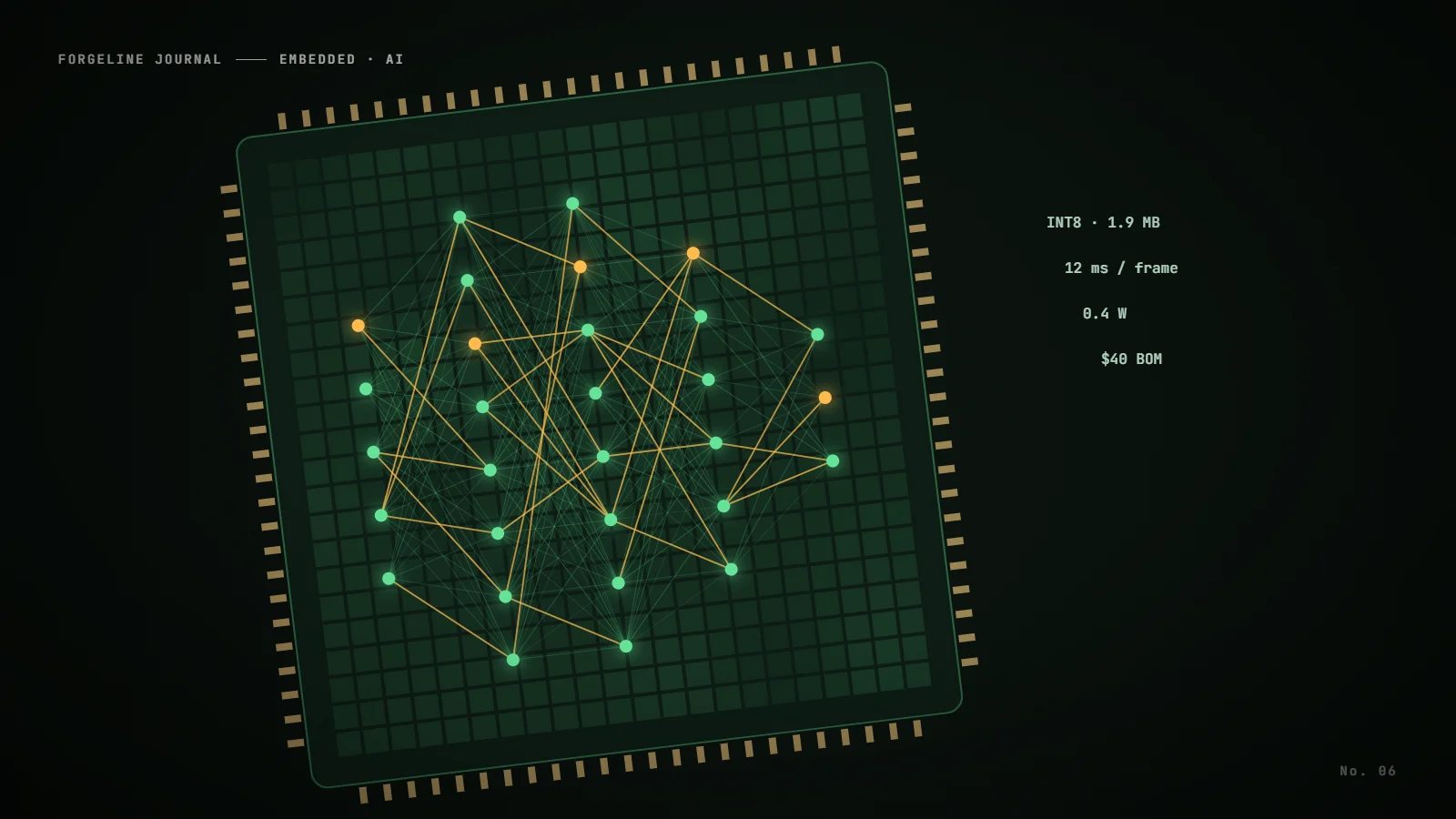
Not every model needs a GPU. Plenty of useful vision tasks run on a microcontroller that costs less than lunch.
Start from the power budget
On battery, the question isn't "how accurate?" but "how many inferences per day can we afford?" Wake on a cheap trigger (motion, light, a timer), run the model, sleep.
Choose a tiny architecture
MobileNet-style and purpose-built micro architectures at 96×96 or 128×128 grayscale go surprisingly far for presence detection, anomaly spotting or simple classification.
Quantise everything
Full int8 quantisation cuts memory by 4× and is required for most MCU accelerators. Use quantisation-aware training if post-training quantisation costs too much accuracy.
Measure on the device
Desktop accuracy means little. Collect data with the actual sensor, lens and lighting, and evaluate on the board — latency, energy per inference and accuracy together.
Plan for updates
Models drift. Signed, resumable over-the-air updates and a way to collect hard examples from the field turn a demo into a product.
Small models on small chips are one of the most underrated tools in the box: private, offline, instant and cheap.
Written by
Vu Nguyen Tuan
Vu leads the Forge and Temper phases: architecture, the weekly demo cadence and the production baseline — CI/CD, tests and observability — that every build starts with.
Follow on LinkedIn